
Tana Toraja Right Now
Air quality in major cities like Jakarta is unhealthy due to traffic, industrial emissions, and waste burning, with the dry season expected to worsen conditions.
Islamic New Year (Muharram)
Best time to visit
Good time to visit
Drier days start to outnumber washouts, making this a practical month for village walks and longer drives around Toraja.
SCORE BY MONTH
Visit between June and September for the driest weather, clearer mountain views, and the best conditions for exploring Toraja’s villages, rice terraces, and burial sites. July and August are also the peak season for traditional funeral ceremonies, bringing bigger crowds and higher prices. Avoid the wettest months from December through March, when persistent rain can make rural roads muddy and outdoor sightseeing less enjoyable.
Visitor data: Estimated from seasonal travel patterns 2026
Day-to-day in Tana Toraja
Walkability
34/100
Tana Toraja is walkable only in short bursts around Rantepao and Makale. Reaching graves, villages, viewpoints, and ceremony sites usually needs a driver, scooter, or guide.
Town centres have short paved stretches, then broken kerbs, parked bikes, stalls, or no footpath.
Rantepao covers basic meals, shops, and guesthouses on foot, but sights sit far outside town.
Motorbikes, cars, and buses share narrow roads with few crossings or pedestrian protections.
Climate works against walking for much of the year. Plan around weather windows.
Need to Know
- Currency
- Indonesian rupiah (IDR)
- Language
- Indonesian and Torajan; English is limited outside guides, guesthouses, and main tourist stops.
- Tap water
- Not safe
- Time zone
- WITA (UTC+8)
- Power plug
- Type C / F, 230V
- Dialling code
- +62
- Driving side
- Left
- Tipping
- Not expected; round up or leave small notes for guides, drivers, and hotel staff.
- Internet
- 4G is usable in Rantepao and Makale; village coverage and guesthouse Wi-Fi can drop out.
- Emergency
- 112 emergency; 110 police, 118 or 119 ambulance, 113 fire.
When not to go
-
Do not chase quiet ceremonies
Jun – Oct · peaks AugDo not come in funeral season expecting private, solemn access. Big ceremonies can pull in tour groups, guides, livestock trucks, and long waits on narrow roads around Rantepao and nearby villages. Come then only if the ritual calendar matters more than quiet, or choose a less ceremony-driven culture trip elsewhere.
Go here instead:
- Sumba Ritual villages and hard travel, with fewer funeral crowds.
- Yogyakarta Easier cultural depth without relying on family ceremonies.
- Chiang Rai Highland pace, softer logistics, and quieter temple days.
Tana Toraja itineraries
Upcoming Events & Holidays
Upcoming events — next 30 days
On the horizon
Public holidays & observances — next 12 months
Dates are researched and checked, but events move. Always confirm with the official source before you book anything around them.
Getting To Tana Toraja
-
From Toraja Airport (TRT)
Closest airport, about 1 hr by road to Rantepao.
Toraja Airport, also called Buntu Kunik, is the closest airport to Rantepao and Makale but has limited domestic service. Arrange pickup before landing, because casual taxi supply is thin compared with Makassar.
-
Overland from Makassar
Main budget route, usually 8 to 12 hr to Rantepao.
The road from Makassar to Rantepao is long, winding, and still the default route when flights are full or poorly timed. Buses usually leave from Makassar's Daya area, with night services saving a hotel night but costing you proper sleep.
Safety Advice
Indonesia has a high risk of natural disasters and a continued threat of terrorism, with specific warnings for Papua. Petty crime like pickpocketing is common in tourist areas, and road travel can be chaotic and hazardous.
Common Scams
-
ATM Skimming and Tampering
HIGH RISKTrigger:The card slot looks loose or cash fails to dispense
A compromised ATM can copy your card data or trap a withdrawal while you stand there thinking the machine failed. The damage is worse in Toraja because cash is still needed outside Rantepao and Makale.
How to avoid: Use ATMs inside bank branches or busy minimarkets, and cover the keypad. Carry a backup card stored separately from your wallet.
-
Unofficial Site Guides
MEDIUM RISKTrigger:A man at Lemo or Kete Kesu starts walking with you
The walk turns into an unwanted tour, then a fee or donation appears at the end. It is usually small to moderate money, but the pressure feels sharper at graves and ceremony sites.
How to avoid: Hire guides through your guesthouse, a known local operator, or the tourist office. Decline early and keep walking if you did not ask for help.
-
Padded Driver Quotes
MEDIUM RISKTrigger:A driver names a vague price for villages and waiting time
Drivers can blur fuel, waiting time, parking, and multiple stops into one inflated final charge. This is most common on day hires from Rantepao to graves, viewpoints, and ceremony villages.
How to avoid: Agree on route, waiting time, fuel, parking, and return point before leaving. Book through your lodging if you do not know the going rate.
Mistakes to Avoid
-
Drinking Tap Water
SERIOUS CONSEQUENCETap water is not safe to drink, and stomach illness can wreck a short Toraja trip fast. Village stays and small warungs are not the place to test your gut.
Fix: Drink sealed bottled water or properly boiled and filtered water. Skip ice unless the venue clearly uses purified ice.
-
Underestimating Cash Needs
MINOR CONSEQUENCECards do not carry you far once you leave main-town hotels and larger restaurants. Entrance fees, guides, drivers, village stops, and small meals often need rupiah in hand.
Fix: Withdraw in Rantepao or Makale before day trips. Split cash across your wallet and bag so one loss does not strand you.
-
Disrespect at Funeral Ceremonies
Torajan funerals are family rites, not open-air theatre for visitors. Loud behaviour, casual clothing, or photographing people and bodies without permission causes real offence.
Fix: Go with a local guide, dress modestly, and ask before taking photos. Follow the family's instructions even when the pause feels awkward.
Money & Payments
Carry rupiah for villages, use cards in Rantepao, and reject DCC by paying in IDR.
-
Cash Carries Toraja
Use Indonesian rupiah for village stops, markets, small warungs, guides, drivers, and site fees outside Rantepao. Carry Rp 20,000, Rp 50,000, and Rp 100,000 notes, because small vendors may not break larger bills.
-
Cards Stay Town-Based
Visa and Mastercard work mainly at larger hotels, tour desks, and established restaurants in Rantepao or Makale. Some merchants still add a 2 to 3 percent card surcharge even though Indonesian payment rules prohibit passing surcharges to customers.
-
Withdraw Before Villages
Use bank ATMs in Rantepao or Makale from BRI, BNI, Mandiri, or BCA before heading to graves, viewpoints, or ceremony villages. Per-transaction limits vary by machine, often around Rp 1,250,000 to Rp 3,000,000 (USD 80 to 190).
-
Reject Home Currency
At ATMs and card terminals, choose Indonesian rupiah instead of your home currency. Dynamic Currency Conversion builds a bad exchange rate into the transaction, so the polite-looking option costs more.
-
QRIS Is Patchy
QRIS is common across Indonesia, and some foreign visitors can pay through compatible wallets such as DANA or cross-border apps. In Tana Toraja, treat it as a backup for town businesses, not a replacement for cash in villages.
-
International Transfers
To send money to a bank account in Indonesia, for things like rent or day-to-day expenses, services like Wise or Remitly usually offer better rates than traditional banks and faster delivery.
You'll typically need the recipient's full name, account number, and SWIFT/BIC code. Some banks may also require a local address.
Costs in Tana Toraja
Indonesia remains incredibly affordable, especially outside the major tourist hubs. You can still find a delicious street food meal for under $2, making it easy to stretch your travel budget.
SIM Cards & Data
Best option for most travellers: an eSIM you set up before you arrive. You'll be online the moment you land, with no airport queue and no tourist pricing.
Travel eSIMs Connect the second you land. Zero hassle. Skip the airport queue and paperwork. Activate before you fly and land connected. Find the best eSIM →Prefer a local SIM?
Buy and register a local SIM before leaving Makassar if you can, because Tana Toraja has fewer official counters and more activation friction. Foreigners need passport registration for Indonesian SIMs, and Telkomsel is the safest pick for Rantepao, Makale, and main roads, though signal can still drop in valleys and remote villages.
What Tana Toraja is Like
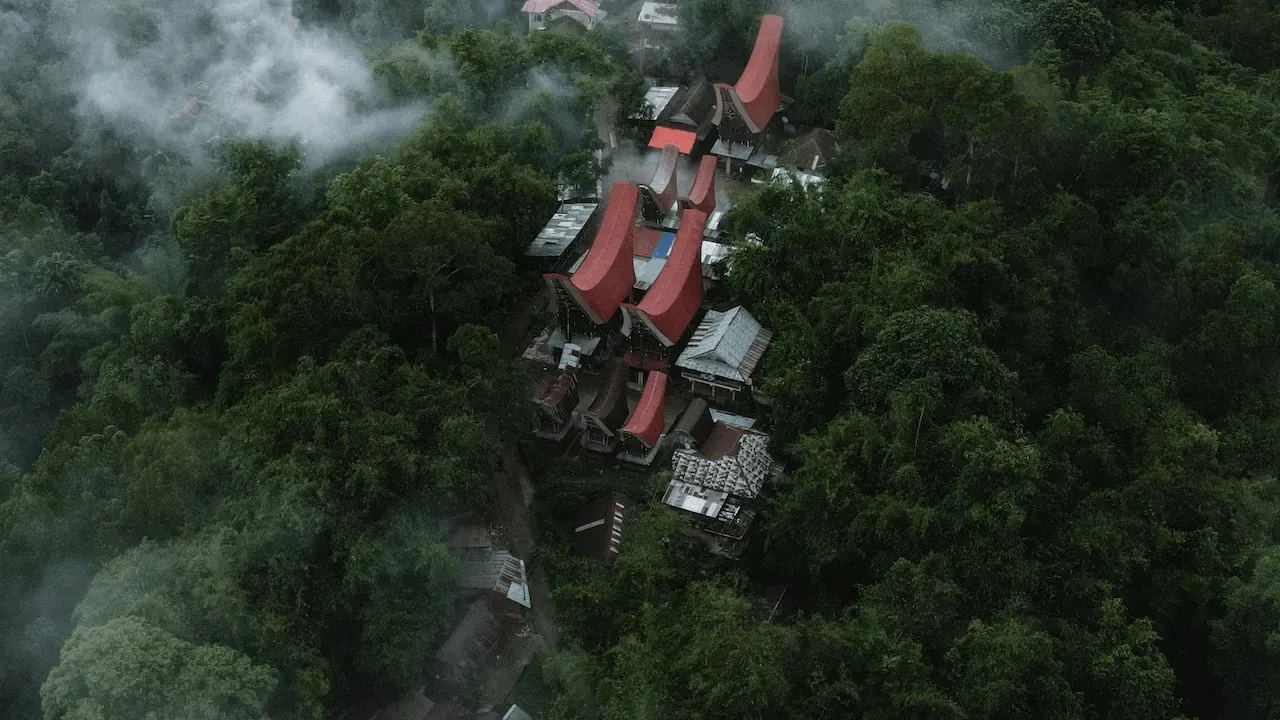
Rantepao is where most trips settle, not because it is pretty in the postcard sense, but because it works. Morning starts with coffee, cigarette smoke, and motorbikes nosing past market baskets, while guesthouses, guide offices, warungs, and minivans all orbit the same practical centre. Makale feels more administrative, with a plaza and government-town rhythm, while the villages outside both towns are where the shape of Torajan life starts to make sense. Do not expect a polished highland resort. Expect a working town that has learned to absorb curious outsiders without rearranging itself for them.
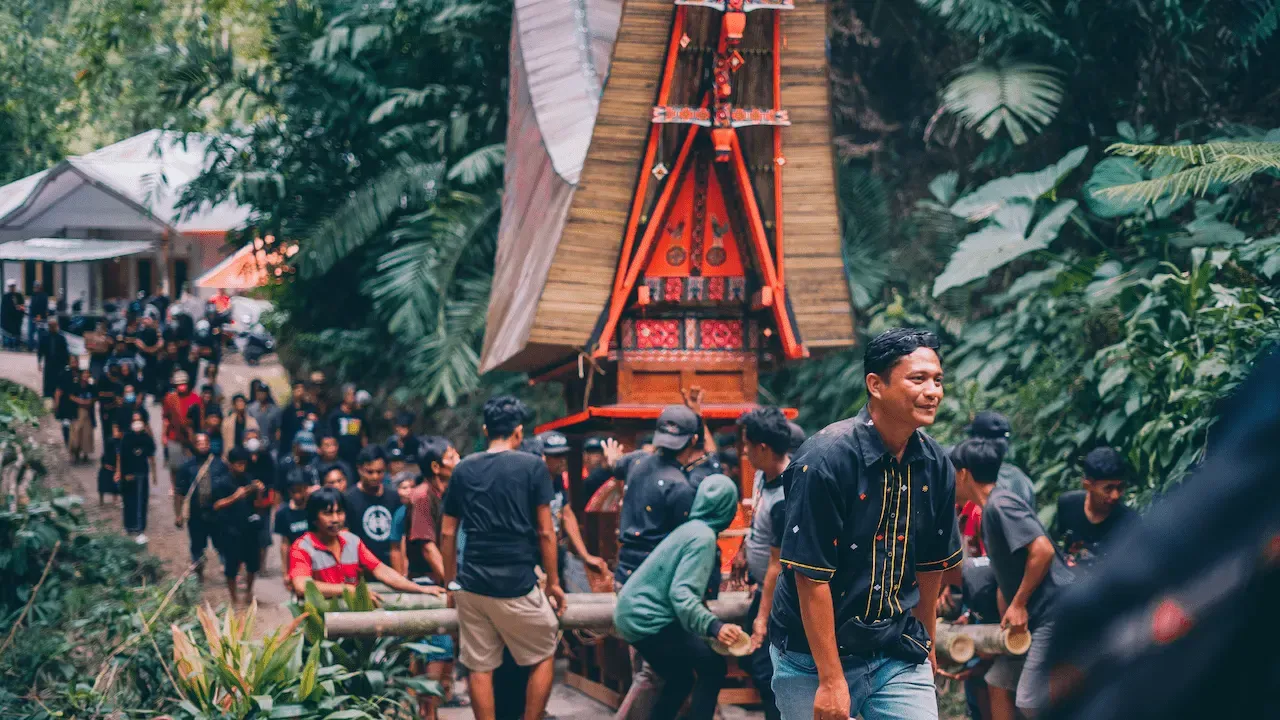
The reason people come is death, which sounds grim until you see how matter-of-factly it sits inside ordinary life here. Funerals can be huge family obligations involving buffalo, pigs, speeches, bamboo structures, visitors, grief, status, and long stretches where nothing happens quickly because nothing about it is simple. The cliff graves at Lemo, the hanging graves at Ke'te Kesu, and the carved tau tau figures are not spooky props for travellers. They are public edges of a private system. If you come looking for spectacle, Toraja will expose you fast.
Away from the ceremony sites, the place opens into ridges, rice terraces, church spires, coffee gardens, and tongkonan roofs lifting like dark boats above family compounds. Batutumonga is the obvious highland day out, but the better moments are often smaller: a dog asleep under a carved house, kids in school uniforms cutting across wet paths, a grandmother selling pa'piong from a smoky roadside kitchen. The landscape is not empty scenery around the culture. It is the reason the culture has this shape.
This is not a clean, soft, quick trip for people who want attractions lined up neatly between cafe stops. Roads take time, plans bend around family ceremonies, and the most interesting days can leave you muddy, quiet, and unsure what you were allowed to understand. Travellers who need constant comfort, strong English everywhere, and culture packaged at a polite distance should choose somewhere easier, maybe Yogyakarta. Toraja rewards patience more than appetite. That is the deal.
Tongkonan House Logic
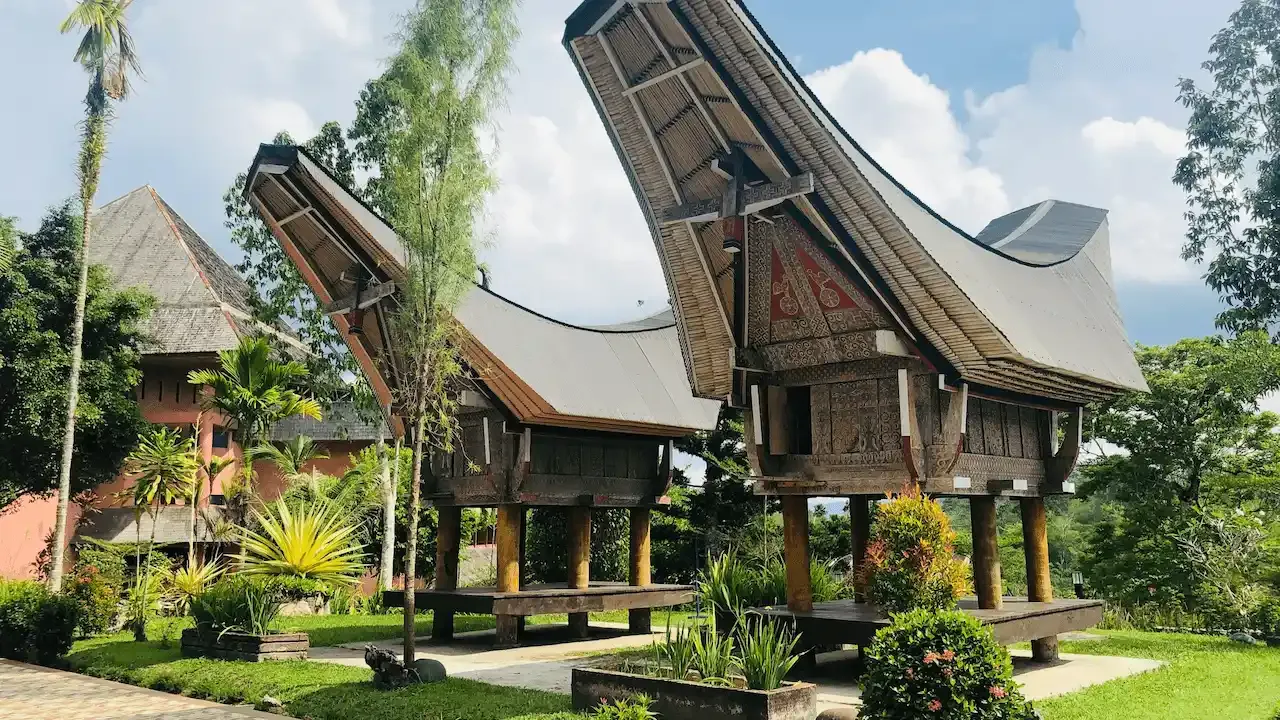
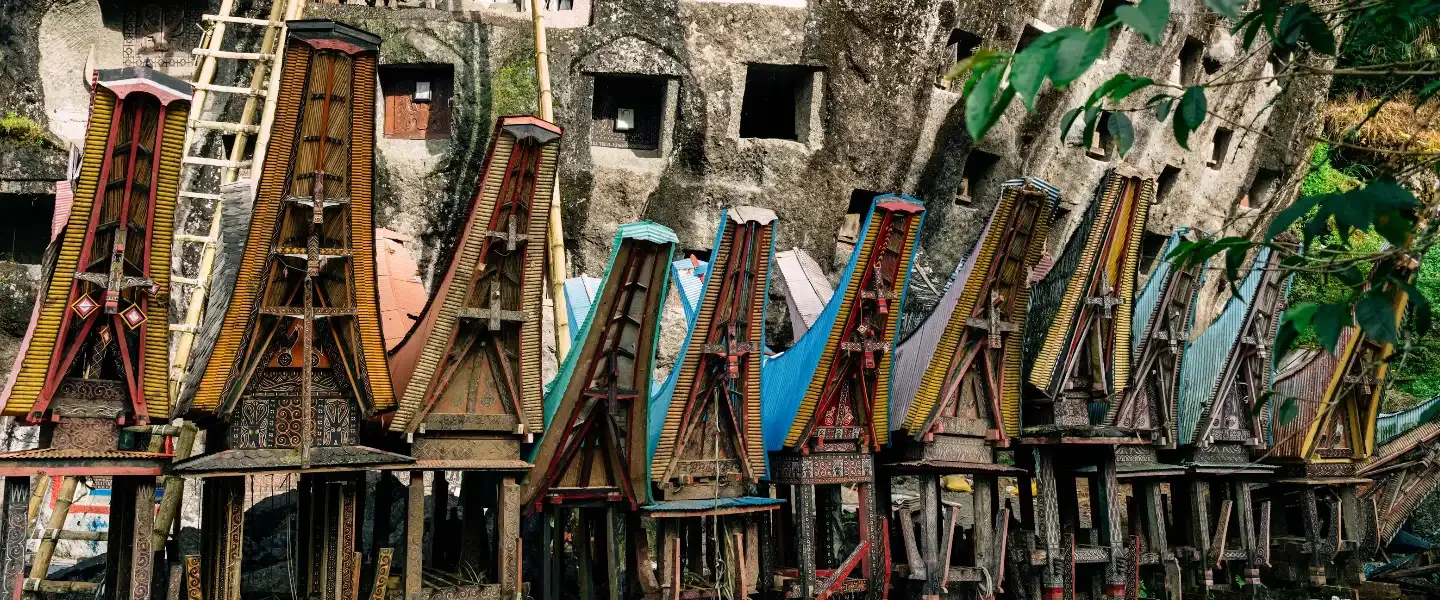
The first thing most visitors notice is the roof, because it is impossible not to: a high curved sweep of blackened bamboo or metal, rising above rice barns like a boat pulled onto land. At Ke'te Kesu, people line up the same shot from the front, buffalo horns stacked on the pillars and red-black-white carvings catching the light. That photo is not wrong, just shallow. A tongkonan is less a pretty old house than a family address, a ceremonial anchor, and a public statement about who belongs to whom.
Look at the layout and the logic starts to show. The ancestral house faces its rice barns across an open yard, with space between them for sitting, receiving guests, sorting grain, and staging the endless negotiations of family life. The carvings are not wallpaper, and the horns are not hunting trophies. They record status, sacrifice, and obligation in a way outsiders can read badly if they only ask whether the house is still lived in. Some are lived in, some are symbolic, and many are both. That is the point.
The tourist mistake is treating tongkonan compounds as architecture museums with better roofs. They are closer to family headquarters, even when the family has scattered to Makassar, Jakarta, or overseas for work. Money comes back for repairs, ceremonies, and the social duty of keeping the house standing because the house keeps the family legible. This is why a compound can feel quiet on an ordinary afternoon and then become the centre of a huge event later. The building is waiting for its role.
Visit one with that in mind and the usual photo stop becomes more interesting, and less grabby. Notice which houses are freshly painted and which are fading, which barns still hold rice, which carvings have been replaced, and where people actually sit when there is no performance to watch. The best guide will talk about kinship before talking about roof shapes. If they start with the photo angle and end at the souvenir stall, you learned almost nothing.
Areas of Tana Toraja
- Cave graves, rural roads
Londa
Londa centres on cave burials, hanging coffins, and dark limestone chambers that feel very different from the open cliff sites. The surrounding area is rural and quiet, with limited visitor infrastructure once you move away from the attraction entrance. It can work as a stay-near option for travellers who want the countryside and do not need much at night. Claustrophobes should base elsewhere.
Good for: Cave burials, rural quiet, travellers comfortable with darker sites.
Skip if: You dislike caves, damp paths, or isolated evening bases.
- Local town, quieter base
Makale
Makale is the government town, with a plaza, local offices, and a slower rhythm than Rantepao. It has some hotels and everyday food options, but fewer guides, tour desks, and traveller-focused services. The trade-off is a more local base with less of the tourist circuit around you. It works best if your driver or guide is already arranged.
Good for: Local town life, quieter nights, travellers with pre-arranged transport.
Skip if: You want the easiest base for guides, restaurants, and day-trip logistics.
- Highlands, views, quiet
Batutumonga
Batutumonga is the highland option above Rantepao, with rice terraces, colder mornings, and roofs breaking through mist when the weather behaves. Staying here gives you the rural version of Toraja, not the convenient one. Meals, transport, and last-minute errands need more planning than they do in town. Come for the slower ridge days.
Good for: Rice terraces, village walks, quiet guesthouses, cooler mornings.
Skip if: You want easy restaurants, ATMs, and flexible evening plans.
- Megaliths, village life
Bori Kalimbuang
Bori Kalimbuang is built around standing stones, tongkonan houses, and a quieter read on Torajan status and ceremony. It has less immediate visual drama than Lemo or Kete Kesu, which is exactly why it can feel less processed. As a base, it is better for slow travellers who want village texture over restaurant choice. Do not stay here to simplify logistics.
Good for: Megaliths, village compounds, slower cultural stays.
Skip if: You have limited time or want the most dramatic sites first.
- Cliff graves, rice fields
Lemo
Lemo is known for its cliff graves and tau tau figures, with rice fields and village roads around the site. It is more of a focused day-trip zone than a natural base, so staying nearby only makes sense if you want rural quiet and already have transport sorted. The area does not give you Rantepao's food, cash, or guide convenience. The graves are the point.
Good for: Cliff burials, quiet rural stays, travellers with a driver.
Skip if: You want town services within easy walking distance.
- Main base, food, guides
Rantepao
Rantepao is the default base because it has the most guesthouses, drivers, guides, warungs, ATMs, and small travel offices in one place. The town itself is practical rather than pretty, with market traffic, motorbikes, and a scruffy service-centre feel. Bolu Market adds proper local texture, especially when livestock trading is active. Stay here if you want Toraja made workable.
Good for: First-time visitors, guide access, restaurants, cash, easy day trips.
Skip if: You want a quiet village stay or polished resort setting.
- Tongkonan, graves, vendors
Kete Kesu
Kete Kesu is one of Toraja's most visited traditional village sites, with tongkonan houses, rice barns, cliff graves, and souvenir stalls pressed into a small area. It is a strong place to visit, but a thin place to base yourself unless you find a nearby homestay and accept the quiet after day visitors leave. Rantepao gives easier food and transport while keeping the site close enough for a simple day trip. Stay nearby only if you want the village setting more than the services.
Good for: Tongkonan architecture, burial sites, quiet village-edge stays.
Skip if: You want a broad choice of restaurants, drivers, and evening options.
Frequently Asked Questions
Planning & moving around
-
What's the best time of year to visit Tana Toraja?
June to October is the strongest window if you care about ceremonies, dry roads, and easier village visits. July and August bring the most visitor pressure because major funeral events are more common, so expect less privacy around famous sites. The wetter months can still work, but muddy paths and slower road days change the trip.
-
How many days do you need in Tana Toraja?
Three full days is the minimum that does not feel rushed. That gives you one day for major burial sites, one for villages and highland roads, and one flexible day for a ceremony or a slower route. Add more time if you are coming overland from Makassar, because the journey takes real energy.
-
What's the best way to get from Makassar to Tana Toraja?
Most travellers either fly from Makassar to Toraja Airport when schedules work, or take the long road to Rantepao by bus or private car. The flight is much shorter but has limited service, while the road trip usually takes most of a day or overnight. If you arrive late in Makassar, sleep there first rather than starting the mountain road tired.
-
Do you need a guide in Tana Toraja?
You can visit many sites independently, but a good local guide changes the trip. For funeral ceremonies, a guide helps with timing, permission, etiquette, and the parts of the event an outsider will misread. Hire through a guesthouse, tourist office, or known local operator rather than accepting a random approach at a site.
-
What's the best way to get around Tana Toraja?
A private driver or guide is the simplest option for burial sites, villages, viewpoints, and ceremonies. Scooters give flexibility, but the roads can be steep, wet, narrow, and shared with trucks and buses. Public minibuses exist, but they are too slow and irregular for most short trips.
-
Are Grab or Gojek available in Tana Toraja?
Do not rely on Grab or Gojek around Rantepao or the villages. Short local rides are handled by ojek, bentor, hotel-arranged drivers, or informal taxis. For day trips, arrange transport through your lodging or guide before you leave.
-
What are the best day trips from Rantepao?
Lemo, Londa, Kete Kesu, and Bori Kalimbuang are the main cultural day-trip stops from Rantepao. Batutumonga is the better pick when you want highland roads, rice terraces, coffee gardens, and a slower village day. Do not cram every site into one loop just to tick names off a list.
-
What's the biggest mistake first-time visitors make in Tana Toraja?
They plan Toraja like a simple sightseeing loop instead of a slow region built around distance, family timing, and ceremony rules. That leads to rushed days, missed context, and too much time on roads. Build in one flexible day and do not treat funeral access like a scheduled attraction.
-
Is Tana Toraja worth visiting without a funeral ceremony?
Yes, if you are interested in tongkonan compounds, cliff graves, village roads, coffee, rice terraces, and Torajan family culture. A funeral adds intensity, but it is not the only reason to come. Do not force ceremony access if the timing is wrong.
Safety & medical
-
Is Tana Toraja safe for tourists at night?
Rantepao and Makale are usually calm at night, with more risk from dark roads, dogs, traffic, and poor lighting than from violent crime. Villages and rural roads get quiet fast after dinner. Use a driver or short local ride if your guesthouse is outside the town centre.
-
What common illnesses affect travellers in Tana Toraja?
Stomach trouble is the most likely problem, especially if you drink tap water or eat carelessly at small roadside places. Mosquitoes are present, so use repellent and cover up in the evening. Bring basic stomach medicine because clinics and pharmacies are thinner once you leave the main towns.
-
Do you need travel insurance for Tana Toraja?
Yes, because Toraja is remote enough that a crash, bad infection, or serious stomach illness can become a logistics problem. Local clinics can handle basics, but serious care may mean transfer to a larger city. Buy insurance that covers road accidents and medical evacuation.
-
Can you drink the tap water in Tana Toraja?
No. Drink sealed bottled water or properly boiled and filtered water, especially in villages and small guesthouses. Brushing your teeth with tap water is usually tolerated by many travellers, but anyone with a sensitive stomach should use bottled water.
-
Is Tana Toraja safe for solo women?
Solo women can travel here, but the harder parts are isolation, transport, and unwanted attention during quiet rural moves rather than a specific crime pattern. Base in Rantepao, use known guides or drivers, and avoid being stranded after dark outside town. Ceremonies are easier and less awkward with a local guide.
Laws & local norms
-
What are the drug laws in Indonesia?
Indonesia has severe drug penalties, including long prison sentences and capital punishment for the most serious offences. Marijuana is illegal, even if you come from somewhere it is tolerated or legal. Do not bring drugs, buy drugs, or treat this as a negotiable risk.
-
What is the dress code for Torajan cultural sites?
Dress modestly at funeral ceremonies, burial sites, and traditional villages. Cover shoulders and knees, and avoid beachwear, loud party clothes, or anything that reads as costume. At ceremonies, darker plain clothing is the safer call.
-
What is the etiquette for attending a Torajan funeral?
Attend with a local guide or host, because funerals are family events with rules visitors do not automatically understand. Sit where directed, speak quietly, ask before taking photos, and do not push forward during sacrifice or mourning moments. A small gift may be appropriate, but follow local advice rather than guessing.
Culture & etiquette
-
What do tourists get wrong about Tana Toraja?
They treat death rituals as the whole story, then miss the family structure, land, houses, markets, and church life around them. The graves and ceremonies matter, but they sit inside ordinary daily routines. Watch what happens between the famous sites, not just at them.
-
How much English is spoken in Tana Toraja?
English is workable with guides, some guesthouses, and traveller-facing restaurants in Rantepao. It drops quickly in villages, markets, and family settings. Learn a few Indonesian basics and let your guide handle ceremony etiquette.
Food & drink
-
Where do locals eat in Rantepao?
Start with small warungs around Rantepao and the market area rather than hotel restaurants. Look for grilled pork, rice dishes, coffee, and simple Torajan cooking where locals are already eating. Ask your guesthouse for current picks, because small places change faster than guidebook listings.
-
What local dishes should you try in Tana Toraja?
Try pa'piong, usually meat or fish cooked with herbs inside bamboo, and pantollo pammarasan, a dark spiced stew often made with pork or buffalo. Ballo, the local palm wine, appears around villages and ceremonies. Torajan food is earthy, smoky, and meat-heavy, not polished restaurant theatre.
-
Are there vegetarian food options in Tana Toraja?
Yes, but it takes work outside Rantepao. Rice, vegetables, tofu, tempeh, eggs, and instant noodles are easy enough, while traditional Torajan meals often lean on pork, buffalo, or chicken. Say no meat, no fish sauce, and no meat broth clearly, because vegetarian can be understood loosely.
Families & kids
-
Is Tana Toraja good for families with young children?
It can work for older, curious children, but it is a hard sell for toddlers and sensitive kids. Long drives, muddy paths, cave graves, animal sacrifice, and thin medical facilities make the trip more demanding than a normal family holiday. Families who come should choose a comfortable Rantepao base and skip the most intense ceremonies.
-
Is Tana Toraja stroller-friendly?
No. Burial sites, villages, markets, and rural paths often involve steps, mud, stones, broken edges, and narrow roads. Use a baby carrier if you are travelling with infants or toddlers.
Staying longer
-
Where should I stay in Tana Toraja?
Rantepao is the easiest base for first-timers because guides, drivers, warungs, ATMs, and guesthouses cluster there. Makale is quieter and more local, but weaker for last-minute tour logistics. Batutumonga or the northern villages suit slow rural stays, not travellers who want easy meals and errands at night.
After dark
-
What is nightlife like in Tana Toraja?
Nightlife is quiet and mostly limited to dinner, coffee, the occasional live music spot, and early sleep before another road day. Rantepao has the most evening options, but this is not a bar-hopping destination. If nightlife matters, Toraja is the wrong stop.